In the June 2026 housing market, many homebuyers are encountering a psychological barrier: sticker shock. When you look at a property listing and see a price tag that is 5% or 10% higher than it was in 2024, your first instinct is often to walk away. It feels like the market has moved out of reach.
However, focusing solely on the "sticker price", the literal dollar amount on the sign, ignores a massive shift in the underlying economics of homeownership. This is what we call the "Real Price" Paradox. It describes a scenario where a house with a higher nominal price in 2026 is actually more affordable for the average household than a cheaper version of that same house was just two years ago. To understand why, we have to look past the list price and examine the relationship between income, interest rates, and carrying costs.
The Affordability Crossing: Wages vs. Inflation
To evaluate the 2026 market accurately, we must look at the "Affordability Crossing." For the first time since the high-inflation era of 2022, household incomes are now outperforming both general inflation and home price growth.
In 2024, many buyers were squeezed by a combination of rapidly rising prices and stagnant purchasing power. Fast forward to mid-2026, and the landscape has rebalanced. Cumulative wage growth across most sectors has effectively lowered the "real" cost of debt. While a home price may have risen from $400,000 to $420,000, the median household income has climbed at a faster rate.
This means that even though the loan amount is larger, the percentage of a monthly paycheck required to service that loan has decreased. Data from June 2026 shows that the typical mortgage-to-income ratio has finally dipped below the 30% threshold for median earners. When your income grows faster than your mortgage payment, your home effectively becomes cheaper over time, regardless of what the sticker says.
The Objective Math: 2024 vs. 2026
Let’s break down the math using a PITI (Principal, Interest, Taxes, and Insurance) comparison to see how this works in a real-world scenario.
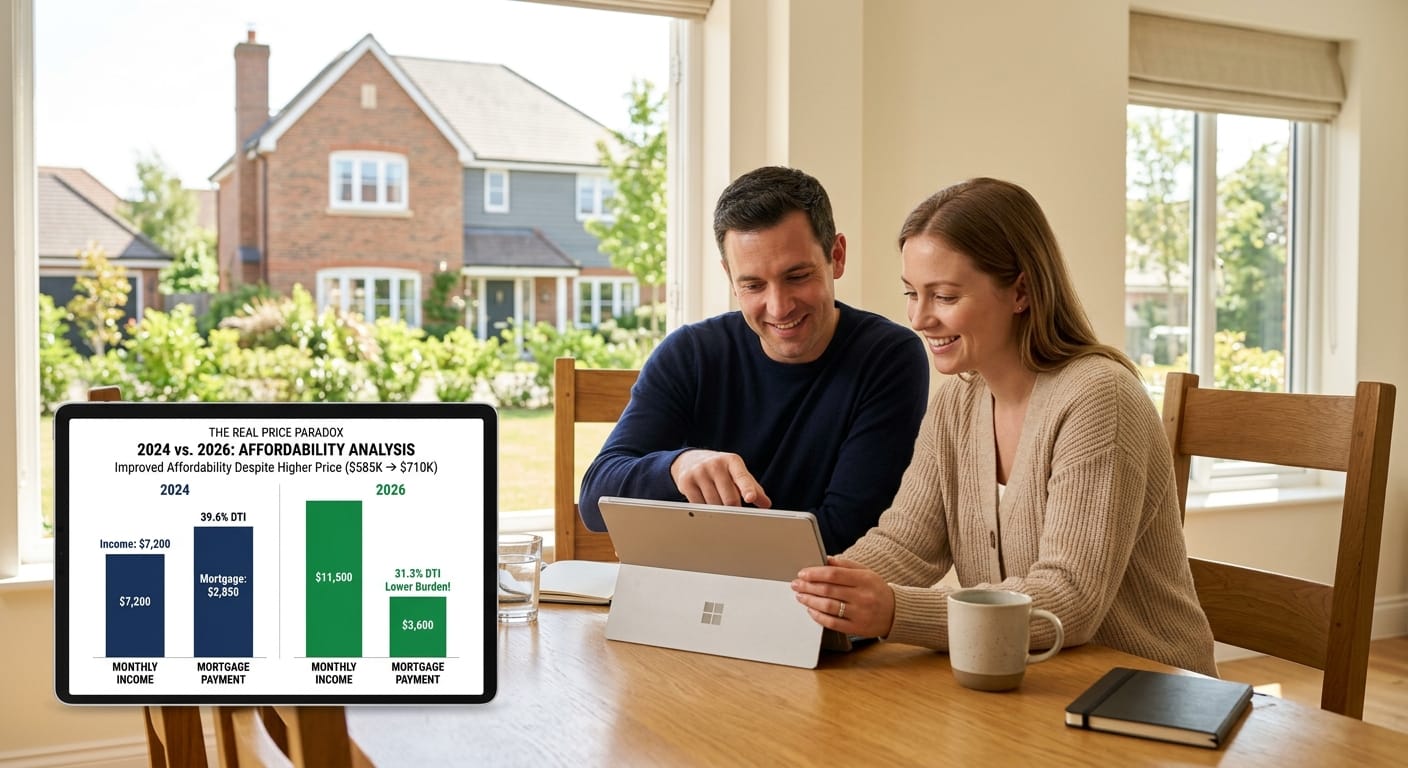
The 2024 Baseline: Imagine a home priced at $400,000 in early 2024. With a 20% down payment ($80,000) and a mortgage rate of 7.0%, the monthly principal and interest payment was approximately $2,128. When you added local property taxes and insurance (the "TI" in PITI), the total monthly carrying cost was roughly $2,650. For a household earning the 2024 median income of $75,000, this monthly cost consumed 42% of their gross monthly pay.
The 2026 Reality: Today, that same home is listed at $420,000, a $20,000 increase in sticker price. However, mortgage rates have stabilized near 6.3%. With the same 20% down payment ($84,000), the monthly principal and interest payment is approximately $2,085.
While the nominal price went up, the monthly payment actually went down. Furthermore, median household incomes have grown to roughly $83,000. When you recalculate the PITI, even accounting for the "Insurance Variable" (higher premiums seen in 2026), the total monthly cost of roughly $2,700 now consumes only 39% of the household's gross monthly pay.
In this paradox, the buyer of the $420,000 home has more "breathing room" in their monthly budget than the buyer of the $400,000 home had two years ago. The debt is mathematically easier to service because the cost of borrowing has dropped and the ability to pay has risen.
The Insurance Variable and Resiliency
A critical part of the "Real Price" Paradox is the cost of protecting the asset. In 2026, insurance premiums have become a primary driver of home valuations. Buyers are no longer just looking at the kitchen or the backyard; they are auditing the "resiliency" of the infrastructure.
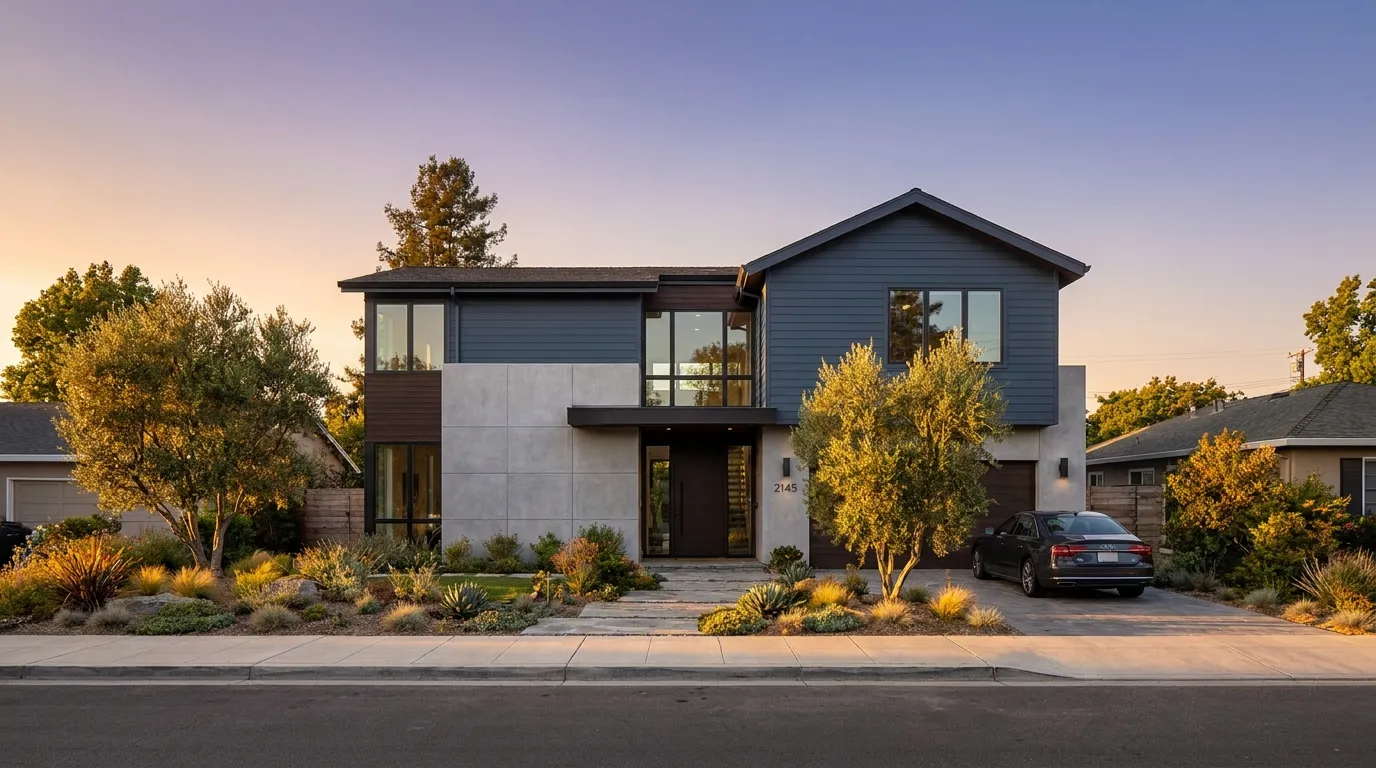
Rising premiums have created a "Resiliency Premium." Homes that have been updated with impact-rated roofs, modernized electrical systems, and smart leak detection are seeing their Estimated Property Valuations stay firm because they are easier and cheaper to insure. Conversely, homes with aging infrastructure are seeing "insurance fallout," where deals collapse because a carrier refuses to bind a policy.
When you see a higher price on a modernized, resilient home, you aren't just paying for the upgrades; you are paying for lower monthly carrying costs. A home that saves you $150 a month in insurance premiums effectively supports a $20,000 higher purchase price without changing your monthly budget.
Why Prices Aren’t "Crashing"
Many people stay on the sidelines waiting for a dramatic price drop, often comparing today’s market to the 2008 crash. However, the structural reality of 2026 is entirely different.
The current market is defined by a "Supply Glut" in some regions and a "Refuge Market" surge in others, but overall, inventory remains restricted by the "Lock-in Effect." Millions of homeowners are currently holding 30-year fixed mortgages at 3% or 4%. They have no financial incentive to sell and trade that rate for a 6.3% mortgage. This creates a floor for prices.
In an environment where supply is low and incomes are rising, prices do not need to crash to create affordability. Instead, the market is finding balance through "Time-Correction." As wages catch up to prices, the "real" price of the home is being discounted every day by inflation and income growth.
The eppraisal Agent: Your Affordability Auditor
Because real estate is hyper-local, national averages can be misleading. A $420,000 home in a high-tax municipal zone might be a bad deal, while that same price in an area with new infrastructure and stable taxes could be a bargain.
This is where the eppraisal Agent acts as your "Affordability Auditor." It moves beyond the Automated Valuation Model (AVM) to provide the "why" behind the numbers. The Agent uses a Reasoning Engine to audit hyper-local data points, including:
-
Municipal Planning: Identifying new transit or utility expansions that will drive long-term ROI.
-
Zoning Shifts: Detecting changes from single-family to higher-density zoning that can impact future equity.
-
Local Tax Trajectories: Comparing current property tax mil rates against scheduled county-wide reassessments.
By inputting your specific income and target zip codes, the eppraisal Agent runs a customized debt-to-income (DTI) stress test. It translates the raw list price into a "True Net Yield" or "True Net Cost," showing you exactly how a specific property affects your bank account. It removes the emotion of sticker shock and replaces it with an objective financial audit.
Navigating the 2026 market requires looking forward rather than anchoring to the prices of the past. Sticker shock is a distraction from the fundamental math of affordability. If your income has grown and mortgage rates have stabilized, the "Real Price" of a home may be lower than it has been in years.
By focusing on your monthly PITI-to-income ratio and the long-term resiliency of the property, you can make a decision rooted in math rather than fear. The data indicates that 2026 is a moment of rebalancing. For the informed buyer, the higher price on the sign is not a barrier—it’s a reflection of a market that has finally reached an equilibrium of value and income.