 By Staff
The Energy Score Spread: How Municipal Point-of-Listing Efficiency Ratings Impact Home Valuation
The Core Takeaway
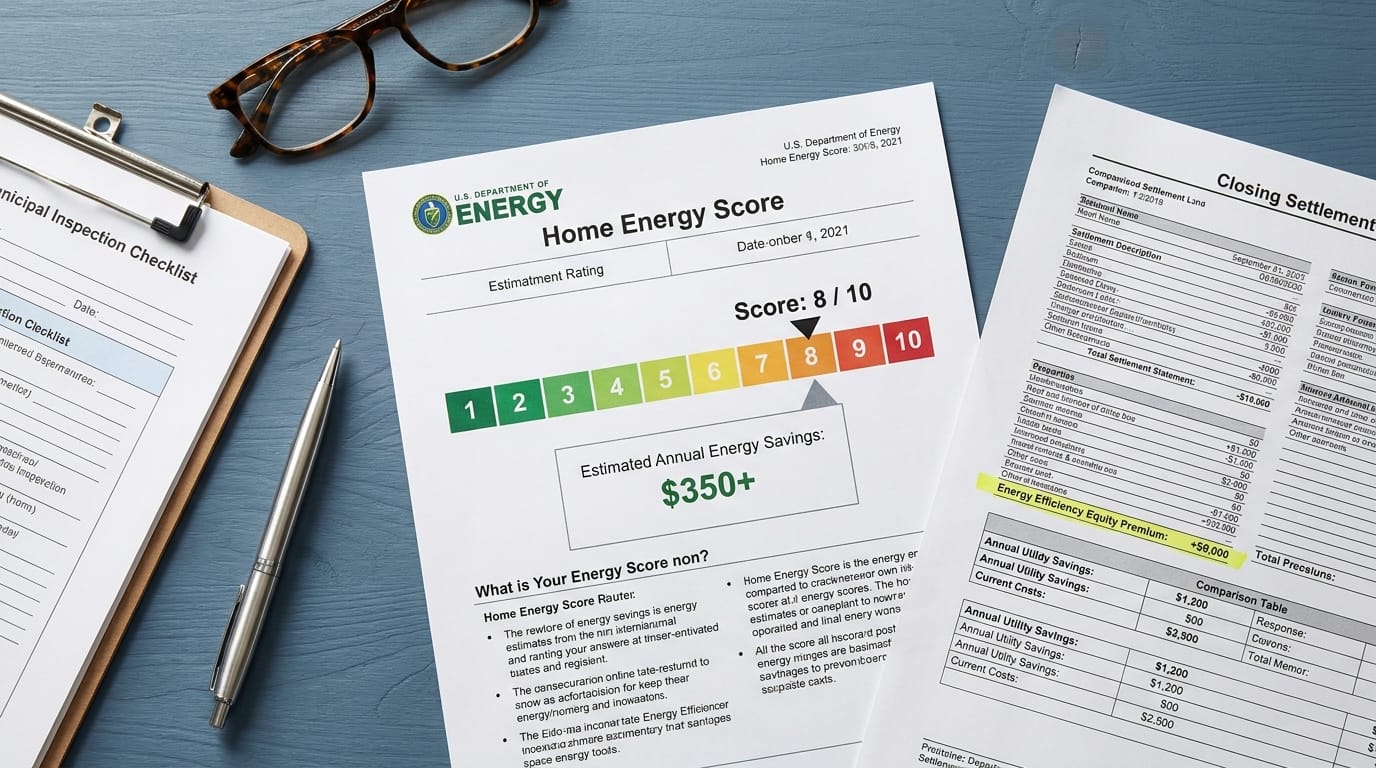
In a growing number of cities, local rules require homeowners to get an official 1 to 10 Home Energy Score before putting a house on the market. Real estate data from Lawrence Berkeley National Laboratory shows that in cities with mandatory scoring, each one-point increase on this ten point scale adds roughly 0.5% to a home's final selling price. In addition, every $100 saved in annual energy costs adds about 0.4% in market value. On a $600,000 home, improving a score from a 5 to an 8 can protect up to $9,000 in equity. On the other hand, homes listed with missing insulation, single pane windows, and aging heating systems receive low ratings that display publicly on real estate listings, giving buyers clear justification to request $5,000 to $15,000 in price cuts or repair credits.
How Point of Listing Energy Scores Work
For decades, home heating and cooling costs were treated as hidden numbers during a real estate transaction. Buyers could look at property taxes, square footage, and recent neighborhood sales, but they rarely knew what it cost to keep the home comfortable until after moving in. That balance of information is shifting across the country as cities pass point of listing energy disclosure laws.
Cities like Portland, Berkeley, Austin, Minneapolis, and Ann Arbor now require homeowners to complete an official energy audit before publicly advertising a home for sale. Instead of looking at past utility bills, which depend heavily on how previous occupants set the thermostat, these assessments use the Department of Energy Home Energy Score. This system measures the physical structure of the house itself.
During an assessment, a certified energy professional inspects more than forty physical features of the property. The inspector checks foundation construction, exterior wall framing, attic insulation depth, window types, heating and cooling system efficiency, and water heater age. The resulting report assigns the house a standardized score from 1 to 10, estimates total energy use in standard measurement units, and calculates estimated annual utility costs in dollars.
In cities where these ratings are mandatory, the law requires the final score and a link to the complete report to be entered directly into the regional Multiple Listing Service. From there, the data feeds automatically into major real estate websites. A home's energy performance rating is now visible to prospective buyers on their phones alongside the asking price, lot size, and annual property taxes before they ever step through the front door.
The Math Behind the Rating: Why Energy Efficiency Directly Impacts Property Value
When energy data becomes public and standardized, it changes how buyers calculate what a property is worth. Economists at Lawrence Berkeley National Laboratory and the UC Berkeley Fisher Center for Real Estate analyzed more than 26,000 home sales in markets with mandatory energy scoring. Their analysis revealed a direct mathematical connection between physical energy ratings, sale prices, and mortgage reliability.
The research identified three clear financial patterns:
- Higher Scores Increase Sale Prices: Each single-point gain on the 1 to 10 scale correlates with a 0.5% increase in the final purchase price. For a $600,000 home, raising a score from an average 5 to an efficient 8 translates to an estimated $9,000 value premium.
- Operating Costs Capitalize into Home Equity: For every $100 reduction in estimated annual utility bills shown on the official report, final sales prices increase by 0.4%. Buyers routinely borrow more and pay higher purchase prices when guaranteed lower monthly utility bills.
- Lower Mortgage Default Risk: The study found that every one point increase in a home's energy score lowers the odds of mortgage delinquency by 5.5%. When homes cost less to heat and cool, homeowners maintain more financial breathing room for their monthly mortgage payments.
The study highlighted an essential distinction: these financial premiums occur only in markets where energy scoring is mandatory for all listings. In voluntary markets, owners of drafty, inefficient houses simply skip the test, hiding poor performance. When every active listing must post its score, buyers can easily compare homes side by side, penalizing inefficient properties while rewarding well insulated ones.
Common Physical Problems That Drag Down Your Score
The Home Energy Score algorithm calculates how quickly heat moves through a home's outer shell and how efficiently the heating and cooling equipment operates. Homes that score in the bottom 1 to 3 range usually share several common, fixable physical issues that accelerate heat loss and drive up estimated operating costs.
The primary structural factors that drag down an energy rating include:
- Thin or Degraded Attic Insulation: In homes built before 1990, attics often contain old fiberglass or loose cellulose insulation with thermal resistance values between R-11 and R-19. Modern building standards recommend R-49 to R-60. Because warm air naturally rises, an under-insulated attic allows 25% to 35% of a home's heat to escape directly through the roof.
- Leaky Air Ducts: Forced air heating and cooling systems with ductwork running through unconditioned attics, basements, or crawlspaces frequently leak 20% to 30% of their conditioned air into spaces no one lives in. This forces furnaces and air conditioners to run longer cycles to keep living areas comfortable.
- Single-Pane Windows in Metal Frames: Old single-pane clear glass windows in uninsulated metal frames let heat pass straight through the glass and framing. In contrast, modern double-pane windows with low emissivity glass coatings and insulated vinyl or composite frames cut thermal loss by more than half.
- Aging Mechanical Equipment: Older natural gas furnaces with efficiency ratings between 65% and 80% lose a substantial portion of their fuel energy straight up the chimney flue. Modern high efficiency condensing furnaces run at 96% efficiency, while variable speed heat pumps deliver heat without burning fossil fuels on-site.
When an energy auditor enters these older materials into the scoring software, the system estimates high annual utility expenses, producing a low numerical score that stays attached to the listing throughout the marketing process.
The Negotiation Risk: How Buyers Use Low Scores Against You
For a homeowner, a low energy score creates an immediate financial vulnerability during price negotiations. When a listing displays a score of 1 or 2 alongside an official projection of $3,500 or more in yearly energy bills, buyers no longer view utility costs as an unknown factor. Instead, the report puts a specific dollar figure on the work required to bring the property up to modern standards.
In balanced and competitive housing markets, buyers use public efficiency ratings to justify lower initial offers or demand substantial repair credits. A buyer who sees high estimated utility bills can calculate the cost of necessary envelope repairs, asking for price reductions or closing credits between $5,000 and $15,000. These requests specifically target major energy projects like complete attic air sealing, new insulation, and furnace replacements.
Because the Home Energy Score is published before the first buyer tours the property, pricing discounts often happen at the initial offer stage rather than weeks later during standard home inspections. Properties with strong scores between 7 and 10 protect their listing price by proving upfront that the home is well sealed and economical to run.
Smart Home Upgrades That Protect Your Long Term Equity
For homeowners focused on preserving long term property equity, targeted energy improvements deliver a clear financial return. These upgrades eliminate the risk of low score price discounts while lowering monthly utility bills right away.
The most practical improvements focus on sealing air leaks and adding insulation rather than spending large sums on cosmetic changes:
- Attic Air Sealing and Insulation: Sealing gaps around plumbing pipes, light fixtures, and framing joints before adding blown in cellulose insulation up to R-49 or R-60 costs between $1,800 and $3,500. This single project typically raises a home's score by 2 to 3 points on the 10 point scale and cuts annual heating and cooling bills by 15% to 20%.
- Sealing and Insulating Ductwork: Sealing exposed joints in heating ducts with professional mastic paste and wrapping uninsulated duct runs in crawlspaces or attics costs $800 to $1,500. This project can recover up to 20% of lost airflow and improves overall heating and cooling output.
- Modern Heat Pump Conversions: Replacing an outdated furnace and central air system with an electric heat pump represents a larger investment ($8,000 to $14,000), but qualifies for federal tax credits under Section 25C of the Internal Revenue Code (up to $2,000) along with local utility rebates. A heat pump upgrade eliminates combustion inefficiencies and can push an overall score into the 8 to 10 range.
- Targeted Draft Reduction: Installing fresh weatherstripping around exterior doors and sealing basement rim joists provides quick improvements in comfort for minimal expense, lowering modeled air leakage on the official assessment.
Addressing thermal efficiency before an energy audit preserves your home's equity. By removing visible performance flaws that lead to $5,000 to $15,000 buyer concession requests, homeowners protect their net proceeds when selling while saving $400 to $1,200 each year in everyday living expenses.
Stay Ahead of Municipal Mandates
Protecting your home's equity means staying ahead of shifting local regulations and structural obsolescence. The eppraisal Agent's Continuous Property Monitoring tracks municipal energy policy updates, zoning shifts, and local tax reassessments in your area, alerting you before new point of listing mandates impact your property's value. When evaluating efficiency improvements, our Property Maintenance Scheduler helps you log structural building envelope wear and quantify the exact equity preservation ROI of replacing aging mechanicals or upgrading insulation. Start your 7 day free trial to see how proactive monitoring keeps you in control of your home's market trajectory.
Share This Article

Join our newsletter!
Enter your email to receive our latest newsletter.