 By Staff
The Resilience Overlay: How Climate Zoning Shifts Your Home Equity
The Summary
The boundaries that define your home’s financial security are shifting due to new municipal "resilience zoning." As local governments activate updated water-trajectory and climate-risk maps, tens of thousands of properties are being reclassified into high-risk tiers, often for the first time. For homeowners, this administrative change creates a critical gap in traditional property tracking. Standard Automated Valuation Models (AVMs) rely on historical data, looking backward at past sales, and often fail to account for these new risks or the municipal projects designed to stop them. Protecting your home equity in this environment requires moving beyond generic estimates. By auditing local infrastructure plans and making specific, high-return upgrades to your property’s mechanical systems, you can stabilize your home’s value. Data indicates that every dollar spent on home-level protection today saves an average of $6 to $13 in future costs, directly securing your equity.
The Invisible Shift in Your Property Lines
For most homeowners, the word "zoning" sounds like a dry administrative topic reserved for city hall meetings or neighbors wanting to build an addition. But now, a new framework called "resilience zoning" is becoming the most important landscape feature you can't see. Unlike traditional zoning, which tells you how high you can build a fence or where a shop can open, resilience zoning maps out how the environment around your home is expected to change over the next several decades.
Local and federal agencies have recently finalized major map revisions that predict where water will flow during extreme "rain-bomb" events, those sudden, massive downpours that overwhelm standard street drains. These maps are significantly more advanced than the old flood charts our parents used; they use high-resolution topography to predict runoff in almost every neighborhood. For a homeowner who plans to stay in their house for the next ten to twenty years, these new charts are a fundamental part of your financial planning. Even if your street has never seen a puddle, being moved into a new "high-risk" zone on these charts changes the way the financial world views your house.
In many metropolitan areas, these newly designated risk zones have grown by more than 40 percent. This means that overnight, the ground under your feet hasn't moved, but your property has been "digitally" relocated into a more expensive and restrictive financial category. This shift affects your mandatory insurance costs, the amount of money you can borrow against your equity, and the price a future buyer will be willing to pay when they eventually look at your home’s record.
The 18 Percent Insurance Transition Ramp
One of the most immediate impacts of being rezoned is the cost of insurance. If your home is moved into a high-risk zone, your mortgage lender will eventually require you to carry additional protection. To prevent homeowners from facing a sudden, devastating spike in their monthly bills, federal and private programs usually use what is known as a "Newly Mapped" procedure.
Rather than your premium jumping from $800 to $3,000 in a single month, the increases are capped, typically at about 18 percent per year. For a homeowner, this feels like a manageable ramp that lets you adjust your budget over time. But while it protects your monthly bank account today, it can create a hidden trap for your equity. If you decide to sell your home five years from now, a buyer’s bank will look at that guaranteed 18 percent annual increase. They will see a rising "bill of ownership" that will eventually make the house much more expensive to hold. To compensate for those future costs, buyers will often demand thousands of dollars in concessions, effectively lowering your final sale price to make up for the rising insurance bill.
Neighborhood Trajectory: The Power of Municipal Defenses
Because your home’s value is tied to its environment, the city's civil engineering projects are some of your most valuable allies. Many municipalities are currently investing millions of dollars into "heavy engineering" defenses, things like high-capacity underground pump stations, storm-surge walls, and large-scale water retention basins.
These projects create clear "protection zones" that shield the homes inside them from the worst of the new map revisions. If your home is located behind one of these certified municipal defenses, your property value is significantly more stable. In fact, research shows that homes within these protected zones can see a 3 to 4 percent increase in value compared to similar homes just a few blocks away that were left outside the defense perimeter. In the world of real estate equity, being on the "right side" of a city pump station is becoming as important as having a modern kitchen.
But staying informed is key. Water physics is a zero-sum game: if a new city project keeps water out of one neighborhood, it often pushes it toward another. This "spillover" effect can cause property values in adjacent, unprotected areas to dip. Awareness of your city's capital improvement plan is no longer just for activists; it is a core part of being a smart homeowner. Using tools to track whether your specific street is on the city’s defense list allows you to stay ahead of these valuation shifts.
Home-Level ROI: Investing in Resilience
While you can't control the city’s budget, you have complete control over your own property’s defenses. This is what we call "mitigation planning," and the financial returns are some of the highest in the real estate market. The National Institute of Building Sciences has found that every $1 spent on making a home more resilient saves an average of $6 to $13 in disaster response and recovery costs.
Here are three high-return paths to protecting your equity:
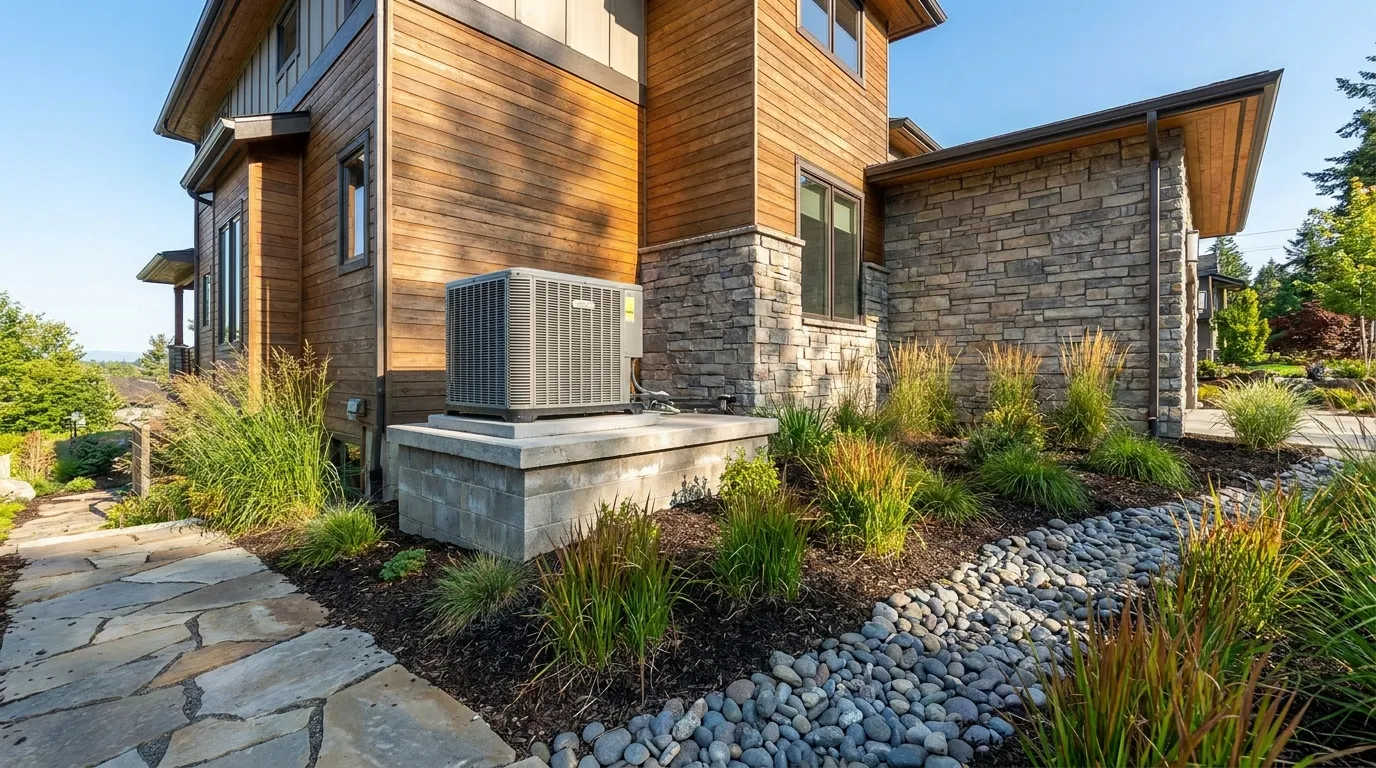
- Protecting the Mechanics: One of the easiest ways to bypass a high-risk score is to move your home’s most expensive systems out of harm’s way. Relocating your air conditioner, furnace, and electrical panel onto a raised platform, even just 18 inches higher. This simple move can lower your annual insurance costs by an average of $1,000.
- Green Infrastructure: Replacing a solid concrete driveway with "permeable" materials that let water soak into the ground, or adding a professional rain garden, shows that your property can handle heavy rain without flooding the foundation. These "green" upgrades can stabilize your value or even provide a local valuation bump of $700 to $2,000.
- Foundation Vents: For homes with crawlspaces or basements in high-risk zones, installing certified foundation vents is a critical safety feature. These vents allow water to flow in and out without the pressure "shattering" your foundation walls. Removing this catastrophic mechanical risk from your home’s record is a major win for your long-term equity.
Asset Preservation in a Changing Landscape
The current climate zoning updates are a natural part of an evolving world, but they don't have to be a threat to your household wealth. The difference between a homeowner whose equity erodes and one whose equity remains stable is access to accurate, forward-looking information. By realizing that standard AVMs are looking in the rearview mirror, you can turn to advanced tools to see the road ahead.
Protecting your property value is about more than just maintenance; it’s about a new kind of "property literacy." When you understand how water patterns and municipal blueprints intersect with your home’s financial record, you gain the power to make confident decisions. eppraisal Agent exists to provide that clarity, acting as your translator so you can keep your home a secure, growing part of your financial future.
Share This Article

Join our newsletter!
Enter your email to receive our latest newsletter.