For millions of U.S. homeowners locked into a 3 percent mortgage, staying put provides a mathematical shield against current interest rates hovering in the low-to-mid 6 percent range. This "lock-in effect" preserves an artificially low monthly housing payment. However, it also obscures a delayed financial impact that can quietly erode those monthly savings: the property tax reassessment cycle.
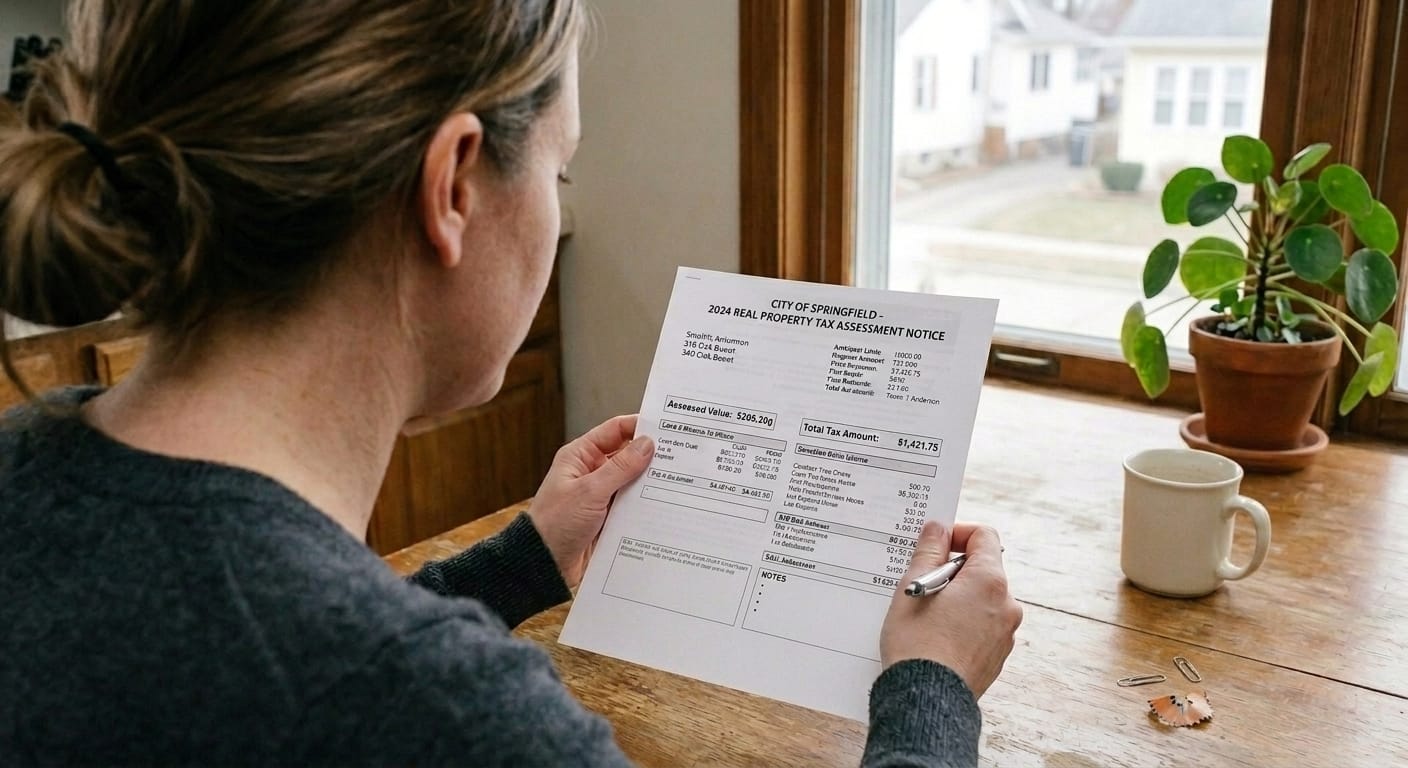
While national price appreciation has flattened, currently sitting at a modest 1 to 2 percent, municipalities operate on lagging timelines. Cities and counties are steadily updating their tax rolls to capture the massive equity gains generated between 2020 and 2024. Depending on your county's specific reassessment schedule, updated notices landing in mailboxes this year can present sudden, spiked property tax bills that threaten to neutralize the benefit of a low-interest mortgage.
Understanding the mechanics of these localized reassessments, and knowing how to mathematically evaluate them, is a critical equity-preservation strategy for homeowners.
The Disconnect: Stalled Markets and Spiking Assessments
To understand why your tax bill may surge while your local housing market feels stagnant, you must look at how municipal revenue is generated. Local governments rely on property taxes to fund schools, emergency services, and infrastructure. They calculate your tax burden by multiplying your home's assessed value by the local mil rate (the tax rate per thousand dollars of assessed value).
During the recent housing boom, property values outpaced many municipal assessment cycles. Now, as cities conduct their scheduled revaluations, they are closing that gap. The inherent problem is that municipalities use bulk valuation methods. They look at broad zip codes and generic recent sales to assign values to tens of thousands of properties simultaneously.
This bulk approach routinely misses hyper-local depreciation. A newly constructed commercial facility increasing traffic noise on your specific street, or the aging infrastructure of an older subdivision, are qualitative factors a bulk assessment ignores. The municipality captures the macro-level appreciation but may miss the micro-level realities that suppress your home's actual market value.
The Mathematics of the Municipal Tax Spike
Let’s break down the exact financial impact of an uncontested reassessment.
Assume you purchased a home five years ago for $400,000 in a municipality with a 1.5 percent property tax rate. Your annual tax burden was $6,000, or $500 per month factored into your escrow.
During the subsequent equity boom, the broad market value of homes in your county surged. The municipality issues a new assessment, valuing your property at $620,000. Even if the local government slightly lowers the mil rate to 1.3 percent to offset the shock, your new annual tax burden is $8,060.
That is a $2,060 annual increase, adding $171 directly to your monthly mortgage payment. Over a five-year holding period, that uncontested assessment drains over $10,000 of liquid capital from your household.
The Appeal Process: Replacing Emotion with Mathematics
When the new assessment notice arrives, passively accepting a flawed valuation is a voluntary surrender of your equity. You have the legal right to challenge the municipality's valuation through a formal property tax appeal.
The critical failure point for most homeowners is how they approach this appeal. Municipal tax boards do not respond to emotional arguments or claims that taxes are simply too high. They require objective, localized data. To win a tax appeal, you must prove a mathematical discrepancy between the municipality's bulk assessment and the specific, verifiable reality of your property.
To build a successful case, focus on three primary data points:
-
Data Errors: Review the property card maintained by the county assessor for objective errors, such as incorrect square footage or an inaccurate designation of finished basement space.
-
Zoning and Infrastructure Friction: Has a recent municipal planning change negatively impacted your street? Increased commercial zoning or proximity to new high-density developments can suppress your specific property value.
-
Misaligned Comparables: The municipality likely used recent sales (comps) from across a wide radius. You must identify specific, recent sales in your immediate neighborhood that closely mirror your home's condition but sold for less than your assessed value.
Deploying Estimated Property Valuations for Your Appeal Strategy
Gathering highly specific, localized data is often the barrier preventing homeowners from fighting their tax bills. Generic consumer real estate portals provide estimates that are no more accurate than the municipality's bulk assessment.
Securing Your Cash Flow
The property tax reassessment cycle is a structural reality. As municipalities seek to capture past equity gains, the burden falls directly onto the homeowner.
Holding a low-interest mortgage is only half of the affordability equation. Protecting your monthly cash flow requires active defense against inaccurate tax burdens. Do not let bulk municipal math dictate your financial reality. Review your assessment notice the day it arrives, pull your objective Estimated Property Valuations to research your comps, and use hard data to protect your equity.