 By Staff
The Inspection Pre-Game: A Buyer’s Guide to Spotting Home Repair Costs Early
The Summary
Checking a home's heating, electrical, and sewer systems before making an offer helps you spot hidden repair costs early. Traditional Automated Valuation Models (AVM) look at past neighborhood sales but often miss the aging machinery inside the property. Spotting these issues allows you to negotiate for price credits before the deal is finalized. The eppraisal platform translates local construction rates into clear insights, showing exactly how the home's physical condition impacts its Estimated Property Valuation.
Touring houses is usually the highlight of the home-buying process. It’s the stage where you start picturing your daily life in a new space, evaluating the light in the living room, or checking the size of the backyard. However, while it’s easy to focus on paint colors and kitchen finishes, the most important parts of a house are often the ones you can't see. Beneath the surface sits a network of physical machinery, heating, cooling, electrical, and plumbing systems, that keeps the building functional and safe.
When you buy a home, you aren't just buying the rooms; you're purchasing the responsibility for all that machinery. If you don't evaluate the health of these systems before you make an offer, you risk inheriting what is known as "deferred maintenance." This essentially means the previous owner put off necessary repairs, and now that bill is being passed on to you. If a major system fails the week after you move in, the financial "deal" you thought you negotiated can quickly disappear.
By treating your initial walkthroughs and open house visits as a simple "pre-game" audit, you can spot expensive warning signs before you pay for a formal professional inspection. You don't need an engineering degree to do this. With a few focused visual checks, you can estimate the remaining lifespan of a home’s infrastructure and ensure the price you pay is fair.
Heating and Cooling: Evaluating High-Ticket Comfort
Replacing a home’s heating and air conditioning (HVAC) system is one of the largest immediate expenses a new homeowner can face. A standard furnace and outdoor air conditioning unit are high-ticket items. In today’s market, installing a new, high-efficiency forced-air furnace typically costs between $9,000 and $16,000. If you also need to replace the outdoor cooling unit, you are looking at a similar investment. If both systems are nearing the end of their lives, you are essentially assuming a $20,000 to $30,000 liability the moment you close the deal.
To protect your budget, you need to understand the typical service life of these units. On average, a well-maintained gas furnace lasts about 15 to 20 years. Outdoor air conditioners and heat pumps usually have a shorter lifespan, often between 12 and 15 years, depending on the climate and how hard they have had to work. When you see a unit that looks remarkably old, rusted, or dirty, you should assume it is operating on borrowed time.
During your walkthrough, you can gather critical data without any special tools:
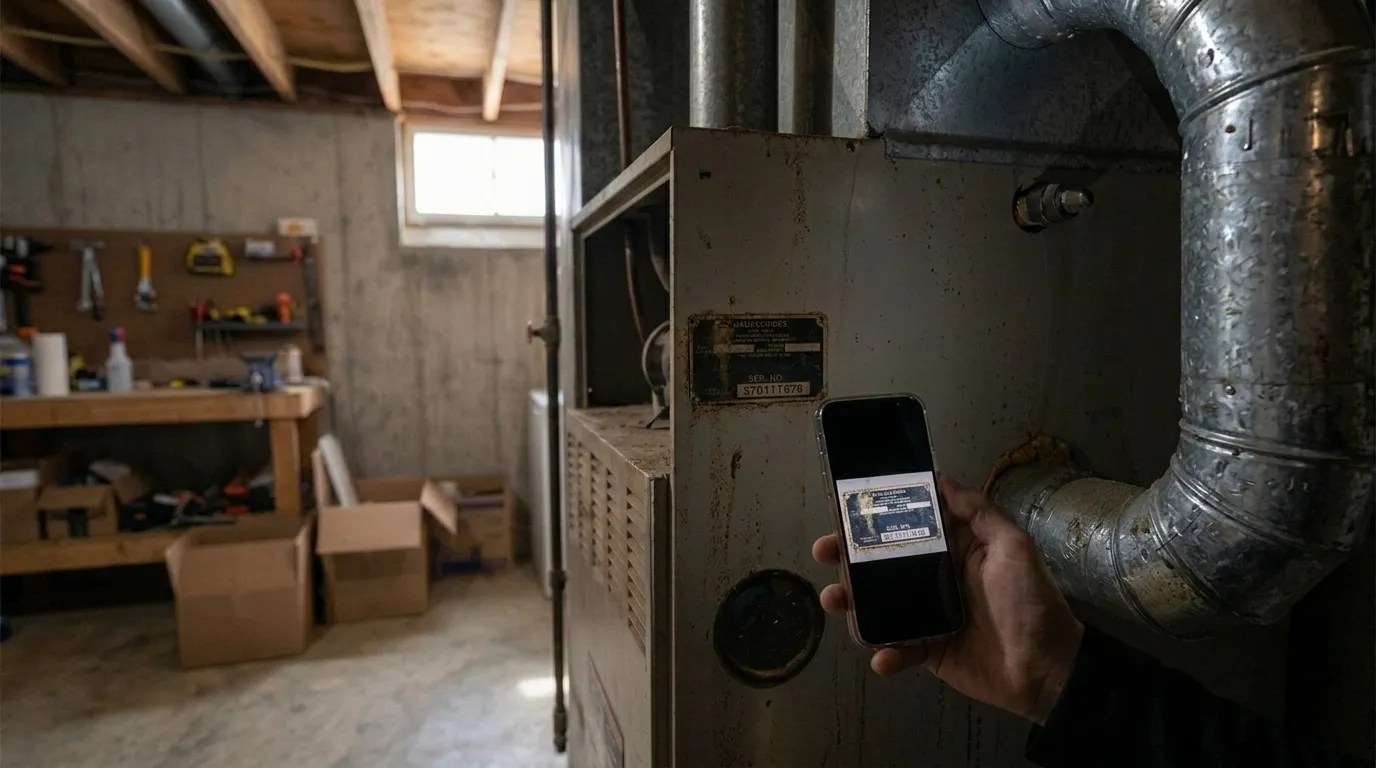
- Check the Birth Date: Almost every furnace and AC unit has a manufacturer’s label (the serial plate). It’s usually a small metal or plastic sticker with a long list of numbers. Take a photo of it. When you get home, a quick search for the brand and the serial number will often tell you the exact month and year it was built. If the unit is 18 years old, you know you’ll be the one paying for its replacement soon.
- Look for "Scale" and Rust: Examine the bottom of the furnace and the pipes connected to it. If you see white, chalky buildup (scale) or orange rust, it’s a sign of past leaks or poor venting. These aren't just cosmetic issues; they indicate the internal components are degrading.
- Listen for Resistance: If the heat or air is running during the showing, listen closely to the vents. High-pitched squealing, repetitive thumping, or a heavy vibration in the floor are signs of worn-out fans or failing motors. A healthy system should be a consistent, neutral hum.
The Electrical Panel: Modern Power vs. the 100-Amp Limit
The way we use power in our homes has changed dramatically over the last twenty years. We now have electric vehicles, high-end induction stoves, and multiple home offices running electronics all day. Because of this, the electrical capacity of a house is a major factor in its real-world utility. Many older homes still rely on 100-amp electrical panels, which were standard decades ago but are now becoming a significant bottleneck.
A 100-amp panel simply cannot safely handle the electrical draw of modern life. If you want to install a Level 2 EV charger, a high-efficiency heat pump, or a large hot tub, a 100-amp panel will likely trip its main breaker constantly. Upgrading this system is a complex task that requires hiring an electrician, pulling city permits, and often having the utility company run new wires from the street to your house. This upgrade usually costs between $8,000 and $12,000, and in some areas with strict safety codes, it can be even higher.
You can check the power capacity yourself by finding the main electrical panel (usually in the garage, basement, or a side closet):
- Read the Main Switch: Open the panel door and look for the largest switch, usually at the very top. There will be a number stamped on it. If it says "100," the house is limited to legacy power levels. If it says "200," the house has already been upgraded to modern standards.
- Check for "Open Slots": Look at the rows of switches (breakers). If every single slot is filled with a switch and there is no empty space left, the panel is "maxed out." Adding even one new outlet or appliance would require a significant and expensive panel expansion.
- Look for Labels: A well-maintained house will have a clearly labeled panel. If the labels are missing or look like they haven't been updated in 30 years, it’s an indicator that the electrical system hasn't been audited for safety recently.
Invisible Risk: The Plumbing and Sewer Audit
Plumbing issues are notoriously difficult to spot because the most expensive pipes are hidden behind drywall, under concrete slabs, or buried deep in the front yard. Because of this "invisibility," plumbing often represents the highest financial risk for a buyer. A single failure in a main sewer line can cost as much as a small car to repair.
In homes built before the mid-1970s, the water supply lines were often made of galvanized steel. Over 50 years, these pipes rust from the inside out. This rust restricts water flow, reduces your water pressure, and eventually leads to "pinhole" leaks that can rot your floor joists. Replacing these old steel pipes with modern, flexible PEX piping is a massive project that costs between $12,000 and $20,000 for a standard-sized home.
Even more critical is the sewer lateral, the underground pipe that carries waste from your house to the city’s main line in the street. In older neighborhoods, these were made of clay or cast iron. Tree roots naturally seek out the moisture in these pipes, grow through the joints, and eventually cause the pipe to collapse. To avoid a disastrous backup on your move-in day, follow these steps:
- Spot the Steel: Go to the basement or utility closet and look at the exposed pipes. If you see silver-grey pipes that are threaded into each other, especially if they have rust "bubbles" at the joints, you are looking at galvanized steel that will likely need replacement.
- Ask the Age: Ask the seller when the sewer line was last replaced. If the house is 60 years old and the pipe is original, it is statistically likely to fail soon.
- The Sewer Scope: While you can do visual checks, you should always hire a professional to perform a "sewer scope" during your formal inspection period. For about $300 to $500, they will run a camera through the line. This is the only way to see if there is a $20,000 excavation project hiding under your lawn.
Every dollar you have to spend on immediate, overdue repairs is a dollar that should be subtracted from the property's estimated value. This is why we built eppraisal. We act as a "Neutral Expert Translator," taking that complex mechanical data and turning it into clear financial insights. Our Home Improvement Budget Estimator allows you to input the age and condition of the HVAC, electrical, and plumbing systems you’ve audited. It then cross-references those details with local contractor rates and labor averages in your specific zip code.
Share This Article

Join our newsletter!
Enter your email to receive our latest newsletter.