 By Staff
The Storage Spread: Why Standalone Solar is Losing Value Without Battery Storage
The Core Takeaway
For active homebuyers evaluating residential properties, understanding the financial performance of existing rooftop solar requires analyzing utility export frameworks like California's NEM 3.0. Standalone solar panels without battery storage now export daytime power at fractional wholesale rates while exposing homeowners to expensive retail pricing during peak evening windows. To maximize energy savings, qualify for favorable underwriting, and lower monthly carrying costs, modern buyers must prioritize integrated battery storage systems that physically store excess power and protect the property against grid blackouts.
The End of the Dollar-for-Dollar Trade
The original financial appeal of residential solar relied on Net Energy Metering (NEM). It operated as a direct, one-to-one financial exchange. If a house generated extra power at noon and sent it to the municipal grid, the homeowner received a credit equal to the full retail price of electricity. You could then use that banked credit to pay for the power consumed at night. The power company essentially acted as a free, infinite battery for the entire neighborhood.
By 2026, this system has ended in major markets, driven by regulatory updates like California's NEM 3.0 and similar avoided-cost export structures nationwide. Utility companies no longer credit homeowners at the full retail rate. Instead, they buy the surplus power back at wholesale prices. This means the extra solar energy generated by a house in the middle of the day earns a credit of just 5 cents per kilowatt-hour. Once the sun sets and the family returns home to activate the air conditioning, the household has to buy electricity back at a massive markup, often exceeding 50 cents per kilowatt-hour. This simple municipal rule change completely wipes out the monthly savings that earlier solar buyers used to enjoy.
The Evening Peak-Pricing Vulnerability
Understanding what a house will actually cost you every month requires looking at when you use power, not just how much electricity the roof produces. The new rules punishing standalone solar panels rolled out alongside mandatory Time-of-Use (TOU) pricing. This means the local utility provider charges completely different prices depending on the exact time of day power is drawn from the grid.
Across the country, the most expensive time to buy electricity is between 4:00 PM and 9:00 PM. This is exactly when solar panels lose sunlight and stop producing energy. A home equipped with just solar panels and no battery has no financial defense against these high evening rates. The property produces its maximum yield between 10:00 AM and 2:00 PM, but without physical storage hardware installed in the garage, the property cannot hold onto that cheap daytime power to use later.
If you buy a home with a standalone solar setup today, you are purchasing an incomplete utility system. You inherit the previous owner's exposure to massive utility bills, seasonal rate hikes, and local grid instability.
Why Battery Storage is the Real Asset
The market shift from traditional solar panels to battery storage systems changes the valuation math for an active homebuyer. A property with an integrated battery system transforms from being at the mercy of the municipal grid to actively controlling its own carrying costs.
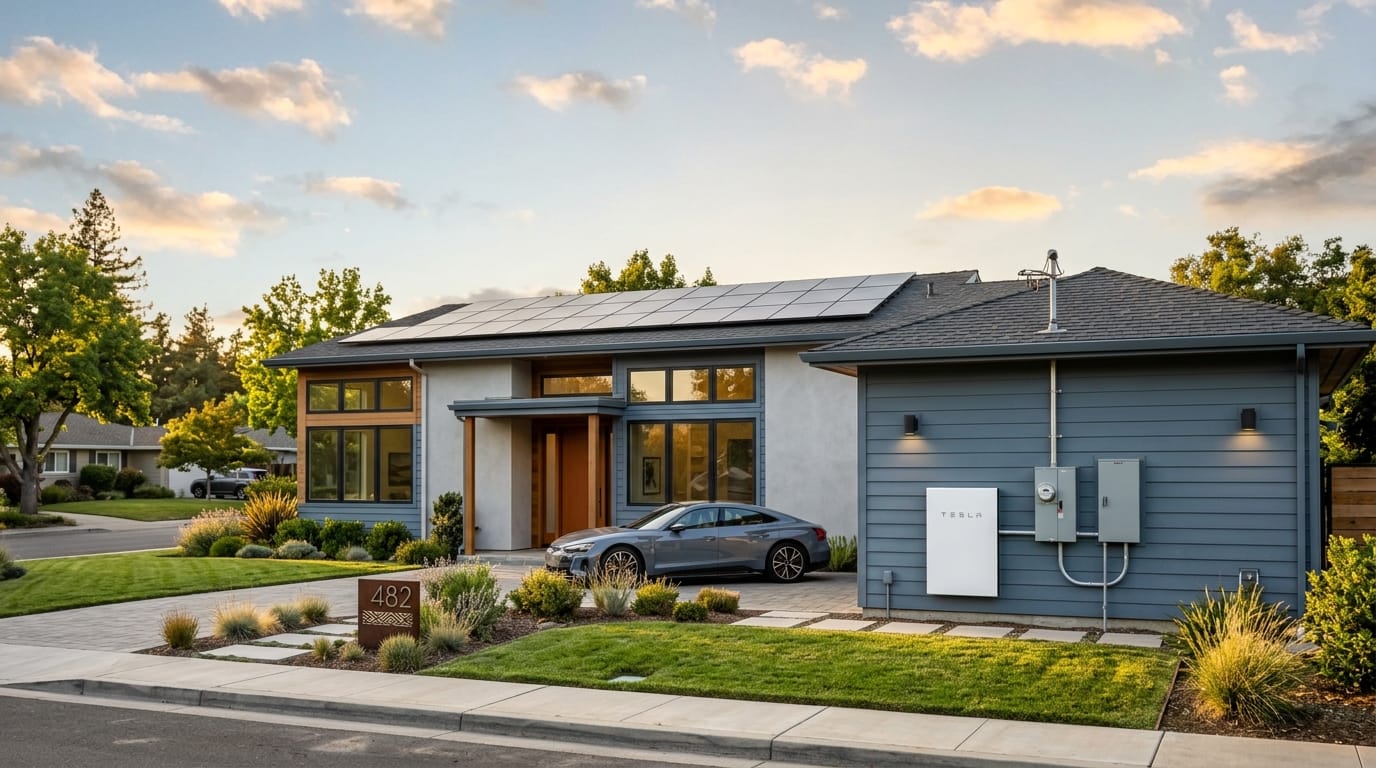
When a home has a dedicated hardware battery (usually sized around 10 to 14 kilowatt-hours of usable capacity), it physically stores the extra daytime energy on the property instead of selling it back to the grid for pennies. Later in the day, the battery-equipped home automatically stops pulling power from the grid. Instead, it runs the electric oven, the cooling systems, and the household lighting by discharging the energy it stored earlier in the afternoon.
By relying on its own stored power instead of paying the steep retail margin for utility electricity, the home executes a localized energy arbitrage strategy. Recent market data shows a standard battery system running this daily discharge cycle can generate $1,200 to $1,800 in direct annual savings for the homeowner. In areas with high peak electricity rates, a house with a dual-battery setup can slash its total monthly utility bill by up to 80 percent. When you calculate your monthly living expenses and debt-to-income limits for a new mortgage, this hardware creates a permanently lower, highly predictable carrying cost.
Keeping the Lights On: The Hidden Flaw of Older Solar
Beyond the daily monetary savings, active buyers must heavily scrutinize home power systems for reliability during neighborhood blackouts. As grid shutoffs and localized brownouts become more common, having reliable backup power acts as a major capital defense.
There is a massive misconception among buyers touring homes: people incorrectly assume that if a listed property has solar panels on the roof, the house will still have electricity during a power outage. A standard grid-tied solar array without a battery will immediately shut down during a blackout. This is a mandatory electrical safety feature designed to physically protect utility workers who are repairing broken power lines.
Therefore, an expensive solar installation without an attached battery provides exactly zero power to the home during an outage, regardless of how brightly the sun is shining. Battery storage systems have the specialized transfer switch equipment required to legally disconnect the house from the main grid and form a safe, independent microgrid. This ensures the solar panels can continue to generate, store, and distribute electricity to the home's essential circuits (such as refrigerators, medical devices, and internet routers) even when the rest of the neighborhood goes dark. To a buyer in 2026, an older solar system that fails during a blackout is a serious liability, while a battery-backed home offers genuine safety and long-term utility value.
Navigating the Valuation and Lending Process
For an active buyer using a conventional mortgage, it is critical to understand how lenders evaluate properties with attached solar infrastructure. When a home goes under contract, the lender sends a professional to establish the physical value of the property. Under modern property evaluation guidelines, an owned solar array can add to the final valuation, but the presence of an integrated battery provides a much clearer, tangible asset value that can be cleanly documented.
However, if the existing solar panels were installed using a solar lease or a Power Purchase Agreement (PPA) rather than being owned outright, the buyer faces a completely different scenario. A solar lease is essentially a secondary lien on the property. As the buyer, you will have to undergo a separate credit check to assume the remaining lease payments from the seller, or demand the seller pay off the lease entirely out of their escrow proceeds. Many sales fall apart when buyers suddenly realize they are inheriting a $20,000 lease liability for an outdated system that doesn't even include a battery to protect against evening utility rates. Always verify whether the solar hardware is fully owned and debt-free before committing earnest money.
How to Value a Solar Home Before You Make an Offer
If you're touring a home that advertises "Owned Solar," require your real estate agent to ask specific questions before drafting a written offer. Because utility export rules have changed so dramatically, you must be methodical to avoid overpaying for an outdated, depreciating system.
Your first step is to demand the system's exact permission-to-operate (PTO) date during the disclosure period. There are three simple categories of solar-equipped real estate you'll encounter on the market:
- Older Grandfathered Systems: Systems installed well before 2024 usually operate under original, favorable net-metering rules. They keep their direct retail exchange privileges for 20 years from the day they were first activated. These systems are valuable because they operate in a financial environment you cannot get today. If the physical hardware passes inspection, this is a strong financial benefit to your purchase.
- Newer Standalone Systems: If a home had solar panels installed recently under new export rules but does not have a battery, it offers the lowest value to a buyer. You will likely need to spend $10,000 to $15,000 out of pocket to add a battery in the future just to make the monthly utility savings materialize. You should mentally deduct that expected retrofitting cost when deciding how much the house is actually worth to you today.
- Battery-Integrated Properties: Homes that already have both solar panels and an integrated backup battery command a distinct premium. These properties provide deep protections against rising utility costs, offer real blackout protection without the noise or fuel requirements of a gas generator, and dramatically lower the actual cost of living in the home.
The New Foundation of Home Utilities
The way the real estate market evaluates a home's power system has permanently changed. Just as buyers stopped accepting outdated 100-amp electrical panels and started requiring modern 200-amp electrical boxes to handle modern loads, having a home battery is the new baseline standard.
A house equipped exclusively with older standalone solar panels today is fundamentally incomplete. It sells its most valuable product for pennies while leaving the homeowner exposed to rising evening utility rates and neighborhood blackouts. When you're looking at houses and running the math on your future carrying costs, remember that the true value is no longer just generating power. The value lies entirely in the home's ability to store that power locally. A property's battery infrastructure is the true key to lowering your monthly bills and protecting your down payment.
Share This Article

Join our newsletter!
Enter your email to receive our latest newsletter.