The Transfer Tax Cliff: How Municipal Bracket Thresholds Dictate Seller Pricing
The Summary
Progressive municipal real estate transfer tax brackets and localized tax cliffs can quickly reduce net seller proceeds. Crossing a statutory transaction threshold by a single dollar often triggers a higher tax rate against the entire gross purchase price.
When you prepare to put your home on the market, your first instinct is usually to aim for the highest possible listing price. Standard pricing advice often suggests testing the top of the market, assuming you can always negotiate downward if buyers push back. In many housing markets today, that standard habit carries a hidden financial trap: the municipal transfer tax cliff.
City and county governments across the country use tiered transfer taxes, often called conveyance fees or deed stamps, to generate revenue for municipal budgets and local infrastructure. While these fees appear on closing statements as routine transaction costs, the formulas used to calculate them can create steep financial drops. In many jurisdictions, crossing a specific price point by just one dollar applies a higher tax rate to the total sale price of the home, not just the balance above the line. That single dollar can instantly erase tens of thousands of dollars from your net sale proceeds.
For active home sellers, understanding how local transfer taxes operate is essential before setting an asking price. It directly shapes your pricing floor, your negotiation strategy during contract talks, and the net cash you walk away with on closing day.
How Transfer Tax Jumps Work: Graduated Rates vs. Total Price Cliffs
To see why transfer tax thresholds cause issues for sellers, it helps to understand how they differ from standard income taxes.
Most homeowners are familiar with graduated income tax brackets. When your annual earnings push you into a higher tax bracket, only the additional income above that specific line is taxed at the higher percentage. Earning an extra $1,000 might increase the tax rate on that specific $1,000, but it never reduces your total take-home pay compared to what you earned before.
Many city and municipal transfer taxes work on an entirely different structure. Instead of taxing only the extra money above a cutoff, crossing the line often applies a higher tax rate to the entire purchase price starting from dollar one. In real estate transactions, this sudden jump is known as a tax cliff.
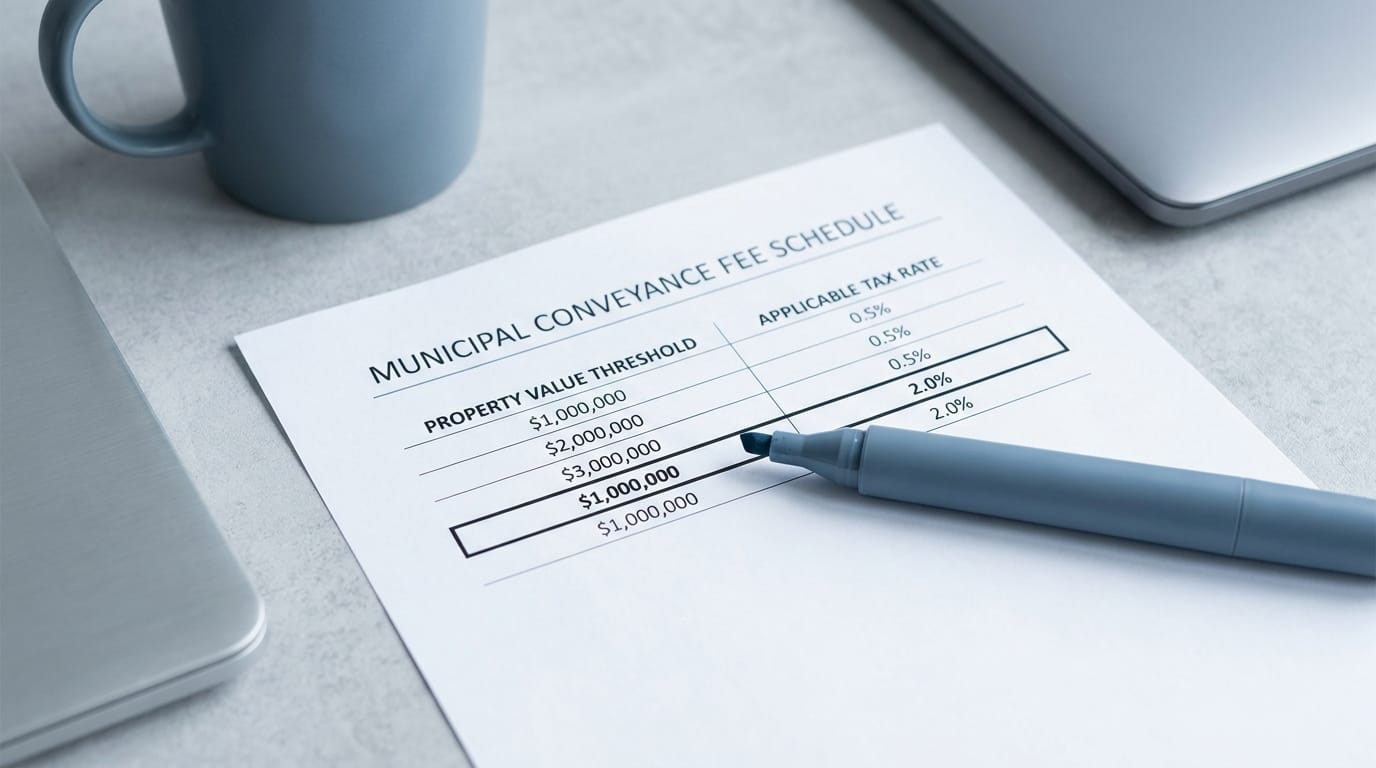
Consider how a transfer tax cliff functions in practice. Imagine your city charges a 0.5% transfer tax on homes selling up to $1,000,000, but increases the rate to 2.0% for any transaction priced at or above $1,000,000:
Sale Price A ($999,999): At the 0.5% rate, the city transfer tax bill is $5,000. Your net proceeds before agent fees and standard title costs equal $994,999.
Sale Price B ($1,000,000): Because the transaction reaches $1,000,000, the 2.0% tax rate applies to the entire amount. The transfer tax bill jumps to $20,000. Your net proceeds before other closing expenses drop to $980,000.
In this situation, accepting an offer that is just $1 higher creates an immediate cash loss of $14,999 at closing. To walk away with the exact same net dollar amount as a $999,999 sale, you would have to sell the property for at least $1,015,306. Any contract price between $1,000,000 and $1,015,300 leaves you with less money in your bank account than selling for just under the million-dollar cutoff.
The Pricing Dead Zone: Why Setting an Aspirational List Price Costs Real Cash
The gap between the statutory tax threshold and the point where you actually break even is what housing analysts call the pricing dead zone. Within this specific window, every additional dollar a buyer pays is absorbed by the municipal tax increase.
Listing your property inside a dead zone causes two practical problems during your sale:
First, it creates an illusion of profit. If you list your home at $1,020,000 and accept an offer at that price, you might assume you secured $20,000 in additional equity compared to a $1,000,000 baseline. But after paying the higher tax rate across the entire $1,020,000 sale, the city tax bill takes $20,400 instead of $5,000. You pay a $15,400 tax penalty, meaning you keep only $4,600 of that $20,000 price increase. Meanwhile, your buyer has to provide a larger down payment and take on higher monthly mortgage payments on that larger loan balance.
Second, homes priced just above major round numbers often spend more time on the market. Active buyers establish round price filters on search portals, such as setting a strict search ceiling of $1,000,000. Pricing a property at $1,015,000 hides your listing from everyone searching up to $1,000,000. When showing traffic slows down, days on market accumulate. When a listing sits for 45 or 60 days without an offer, buyers begin wondering if the home has hidden defects. Sellers then find themselves making reactive price cuts that land below the threshold anyway, having lost their early listing momentum.
Where Tiered Transfer Taxes Apply Across the Country
Tiered transfer taxes are no longer restricted to luxury resort towns. Municipalities and county governments across multiple states have established progressive fee schedules that apply directly to typical single-family homes, townhomes, and condos.
In California, cities like Los Angeles enforce Measure ULA, where property transactions crossing multi-million dollar tiers trigger substantial tax percentage jumps applied to the gross sale price. Crossing the threshold by a small margin creates an immediate six-figure tax difference that comes directly out of seller equity.
In East Coast housing markets, transactions frequently trigger multiple overlapping transfer taxes. Properties in New York often face city conveyance fees, state transfer taxes, and additional mansion tax brackets at the same time. Even when a tax is formally assigned to the buyer, it pulls directly from the buyer's available cash reserves, limiting the maximum purchase price they can offer you.
Statutory updates in states like New Jersey place higher conveyance fee obligations directly on the seller side of the closing statement for transactions exceeding specific million-dollar markers. Furthermore, local governments across Illinois, New Mexico, and Washington regularly update local transfer tax brackets through voter referendums and municipal ordinances to fund local housing and infrastructure initiatives. Because these rules are enacted at the city and county level, properties in neighboring school districts or adjacent zip codes can have vastly different tax bills on the exact same sales price. Confirming your specific municipal code before setting your list price is a vital step in protecting your equity.
Integrating Tax Thresholds into Your Net-Sheet Modeling
When selling a home subject to tiered transfer taxes, shifting your attention from the top-line asking price to net take-home proceeds completely changes how you evaluate incoming offers. Real estate analysts manage this risk by modeling net breakeven spreads before going to market.
Before publishing your listing, calculating the exact dollar amount needed to offset any local tax jump ensures you do not accept an accidental loss. If crossing a local bracket adds $15,000 in transfer taxes, you need to verify whether recent neighborhood sales genuinely support pricing the home $30,000 to $40,000 above that threshold. If local sales support pricing only $5,000 or $10,000 over the line, pricing slightly below the cutoff preserves more take-home cash.
This pricing strategy aligns directly with how active buyers shop for homes. Buyers set rigid filters on property search engines, searching in clean increments like $750,000 or $1,000,000. Positioning your list price at $995,000 rather than $1,010,000 captures search volume moving up to a clean million-dollar cap. That broader exposure drives higher open house turnout and competitive buyer interest, giving you stronger leverage to negotiate cleaner contract terms.
Managing tax thresholds during escrow requires similar discipline. Entering a purchase contract slightly above a tax threshold creates vulnerabilities during the home inspection phase. If you accept an offer at $1,005,000 and the buyer later requests a $10,000 credit for roof repairs, reducing the purchase price to $995,000 avoids thousands of dollars in transfer taxes. However, changing the contract price mid-transaction requires updating lender disclosures, revising title paperwork, and resubmitting loan underwriting files, which can cause closing delays. Establishing an accurate pricing baseline from day one helps prevent these transaction disruptions.
In certain jurisdictions, separating personal property from real estate offers a legal way to structure transactions. Buyers frequently request to buy patio furniture, major appliances, or specialized home equipment alongside the house. Because transfer taxes apply strictly to the underlying land and physical structures, using a separate bill of sale for personal property (properly drafted by a real estate attorney or tax advisor) keeps the real estate contract below a statutory tax threshold while fairly compensating you for personal items included with the sale.
Using Objective Data to Find Your Property Baseline
Selecting an effective listing price requires precise, localized data rather than guesswork. When a pricing difference of just a few thousand dollars can trigger a major tax penalty, relying on rough estimates or broad regional averages puts your net equity at risk.
Sellers can use eppraisal Agent to run a localized Net Yield Audit alongside their Estimated Property Valuation, identifying nearby municipal tax thresholds to calculate whether pricing at or just below statutory transfer tax tiers maximizes net proceeds.
FAQs
No. Eppraisal is strictly an AI-powered software platform, not a licensed brokerage. It does not list properties, represent buyers or sellers, or facilitate financial transactions. Instead, the platform provides objective analytical tools and contextual real estate data to help you make fully informed property decisions independently.
Crossing specific municipal transfer tax thresholds often triggers a cliff penalty where the higher rate applies to the entire transaction. This structural jump directly reduces your net seller proceeds, meaning a slightly higher sale price can actually leave you with less take-home equity.
Pricing a home slightly below a major transfer tax threshold prevents sudden statutory fee spikes applied to the gross sale price. By modeling net proceeds beforehand, sellers can often preserve more immediate cash at the closing table than they would by chasing a marginally higher offer.
The mansion tax impact on home sellers now frequently extends beyond traditional luxury properties due to stagnant, unadjusted municipal brackets. As baseline Estimated Property Valuations rise nationwide, standard single-family homes increasingly cross these statutory limits, exposing everyday sellers to steep transfer tax cliffs during their transactions.
The Summary
When you buy a home with leased solar panels, you inherit the previous owner's third-party debt, not an equity-building asset. These Power Purchase Agreements (PPAs) trigger UCC-1 fixture filings that act like liens, severely tightening your Debt-to-Income limits and causing major
The Core Takeaway
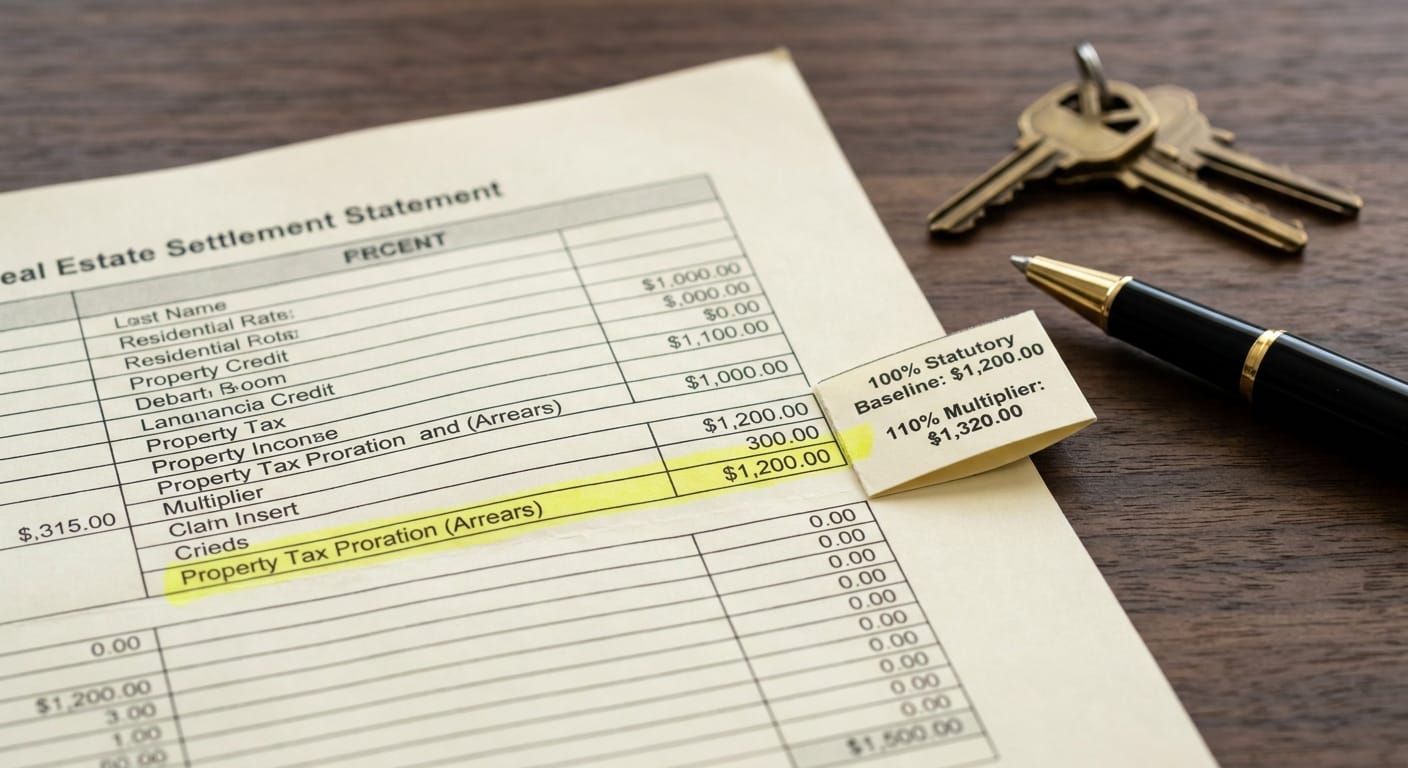
If you sell a home in a state that bills property taxes in arrears, you must credit the buyer at closing for the days you lived in the home during the unbilled tax period. Because the final county tax bill is unknown at settlement, standard real estate
The Factual Summary
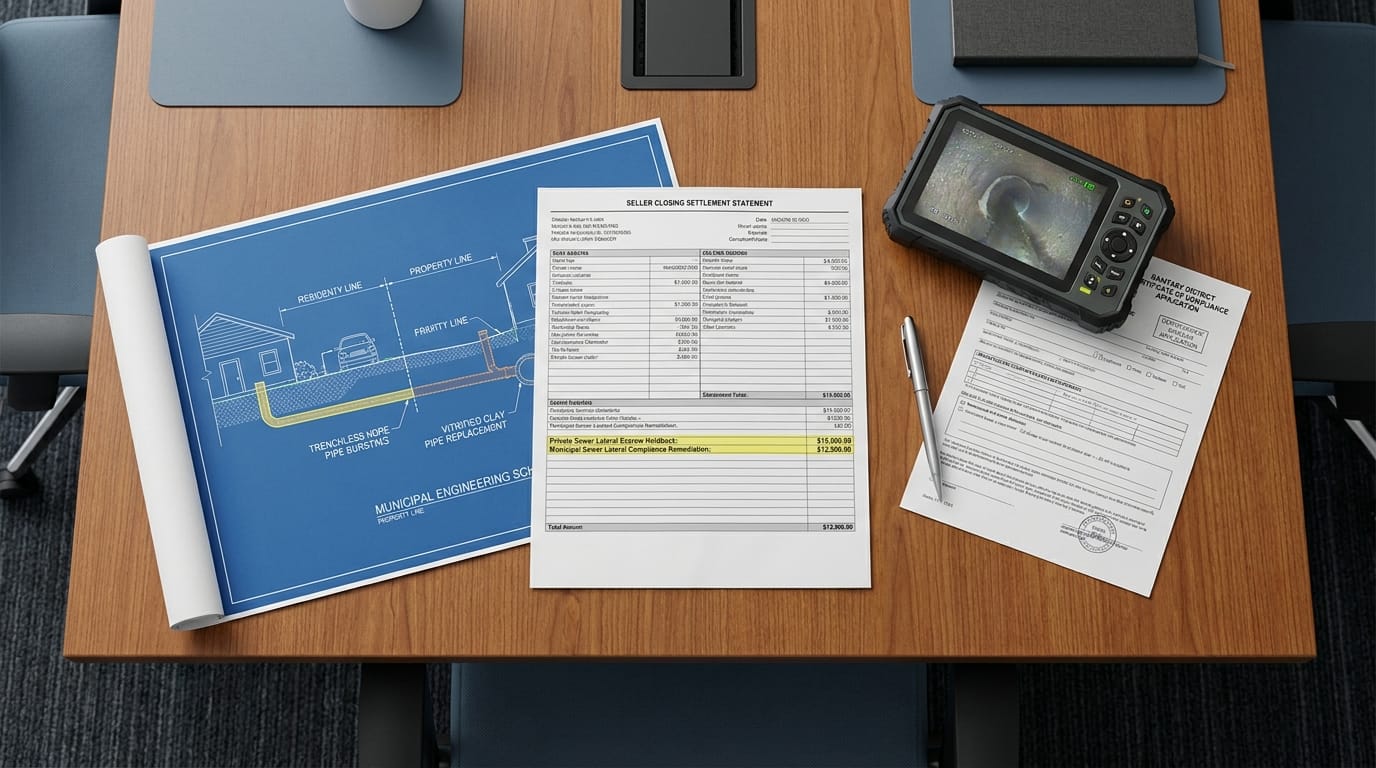
In an increasing number of cities operating under federal clean water agreements, local laws shift major underground infrastructure expenses onto home sellers. These point-of-sale ordinances require sellers to secure an official Private Sewer Lateral Certificate of Compliance before transferring property title. Because older clay, cast-