The Special Tax Spread: How Community Facilities District Levies Suppress Buyer Purchasing Power
The Factual Summary
Community Facilities Districts (CFDs), Mello-Roos districts, and Local Improvement Districts (LIDs) fund neighborhood infrastructure by adding fixed annual fees to your county property tax bill, typically lasting 20 to 30 years. Because mortgage lenders count these $250 to $650 monthly charges as mandatory debt rather than equity-building payments, they reduce your home buying power by $35,000 to $80,000. Checking your official county property tax bill, reviewing district payment formulas, and confirming bond expiration dates before making an offer helps you calculate your true monthly payment instead of relying only on the listing price.
When you tour homes in a new master-planned community or a recently built subdivision, the listing price rarely tells the complete financial story. Most buyers focus on the standard numbers: the asking price, the cash down payment, current mortgage interest rates, and a basic estimate for local property taxes. In thousands of new neighborhoods across the country, an extra line item appears on the property tax roll that can dramatically alter your monthly budget: municipal special assessment district taxes.
Depending on where you're shopping, these fees carry different regional names. You might hear them called Community Facilities Districts (CFDs), Mello-Roos taxes in California, or Local Improvement Districts (LIDs) in other states. These special financing districts fund public infrastructure by selling long-term municipal bonds backed by tax liens on each individual home. While these districts help build modern roads, neighborhood parks, water networks, and community schools, they also create a fixed monthly charge that often lasts for 20 to 30 years or longer.
An extra special tax charge of $250 to $650 every month doesn't build home equity, and it doesn't reduce your mortgage loan balance. Instead, mortgage lenders treat these assessments as mandatory housing debt. When mortgage interest rates hover between 6.0% and 6.5%, that extra monthly expense can reduce your mortgage borrowing capacity by $35,000 to $80,000. Understanding how special assessment bonds work, how lenders calculate their impact on your loan application, and how to read an itemized tax bill gives you the clarity you need to shop with confidence.
What Are Community Facilities Districts and Special Assessment Bonds?
Building a brand-new residential community requires a large amount of upfront construction. Before anyone can move in, local governments must put major public facilities in place, including paved roads, storm drains, sewer pipes, water mains, fire stations, and neighborhood parks.
In past decades, city governments or homebuilders paid for these projects directly. Today, local cities and counties rarely have the upfront budget to fund new suburban growth, and homebuilders prefer not to tie up millions of dollars in site infrastructure. State laws solved this by allowing local governments to create special financing districts over undeveloped land.
Under laws like California's Mello-Roos Community Facilities Act of 1982 and similar rules across the country, a local city or county forms a specialized taxing district over raw land. The district sells municipal bonds to private investors to raise cash for public construction. To pay back those investors over time, the district places an annual special tax directly on each residential lot inside the community boundaries.
Unlike standard property taxes, which are calculated as a simple percentage of your home's assessed market value, Community Facilities District charges are non-ad valorem fees. This means they aren't based on what your home is worth. Instead, they follow a legal formula set when the neighborhood was first approved, known as the Rate and Method of Apportionment (RMA). These formulas calculate your annual charge based on home square footage, lot size, number of bedrooms, or home type.
These infrastructure bonds typically run for 20 to 40 years before they expire. Many district charters also include built-in inflation escalators, allowing the annual charge to increase by 2% to 4% each year until the bond debt is fully paid off.
How Mortgage Underwriters Evaluate Special Assessment Taxes
The biggest financial hurdle for active homebuyers happens during loan pre-approval and mortgage underwriting. Mortgage lenders review your finances using Debt-to-Income (DTI) ratios to make sure your monthly gross income comfortably supports all of your recurring debt payments.
Loan guidelines from Fannie Mae, Freddie Mac, and the Federal Housing Administration (FHA) examine two main debt numbers:
Front-End Housing Ratio: The share of your monthly gross income dedicated to mandatory housing expenses, commonly known as PITIA (Principal, Interest, Taxes, Hazard Insurance, and Association dues).
Back-End Total Debt Ratio: The share of your gross income required to pay all recurring monthly debts, including car payments, student loans, minimum credit card bills, and your full housing payment.
Mortgage underwriting rules require that all special assessments, parcel taxes, and district charges listed on the official property tax bill must be added directly into your front-end housing expense. Lenders do not treat special assessment taxes as optional household living costs. Because unpaid property taxes can result in a tax lien that takes legal priority over the bank's mortgage, lenders treat them as senior debt obligations that must be paid every month.
Because your lender caps your maximum monthly debt payment, every single dollar that goes toward a Community Facilities District fee reduces the dollar amount you can put toward your monthly mortgage principal and interest payment.
The Purchasing Power Math: How Monthly Levies Reduce Borrowing Capacity
To see how special taxes shrink your buying power, look at the direct relationship between monthly payments and loan balances. With a 6.5% fixed interest rate on a standard 30-year mortgage, every $100 of monthly principal and interest payment supports roughly $15,820 in loan balance.
When a home carries an annual special assessment charge, your maximum qualifying loan size drops across common fee levels:
$250 Monthly Special Tax: Lowers your maximum loan amount by approximately $39,550.
$400 Monthly Special Tax: Lowers your maximum loan amount by approximately $63,280.
$550 Monthly Special Tax: Lowers your maximum loan amount by approximately $87,010.
$650 Monthly Special Tax: Lowers your maximum loan amount by approximately $102,830.
For example, if you qualify for a maximum total monthly housing payment of $3,500, buying a home with a $500 monthly special assessment reduces the money available for your mortgage principal and interest from $2,700 down to $2,200 (assuming baseline property taxes and home insurance remain constant). That difference means you must either bring significantly more cash to the closing table as a down payment or choose a home with a lower purchase price.
Comparing Master-Planned Subdivisions to Established Neighborhoods
When evaluating properties online, many buyers assume that a lower sticker price automatically leads to a lower monthly payment. In markets where newer master-planned subdivisions compete against older established neighborhoods, special assessment fees can make comparisons confusing.
Here is a side-by-side look at two single-family homes in the same regional market:
Property A: New Master-Planned Subdivision
Listing Price: $550,000
Down Payment (20%): $110,000
Loan Amount: $440,000 at 6.5% interest (30-Year Fixed)
Monthly Principal and Interest: $2,781
Standard Property Tax (1.1% base rate): $504 per month ($6,050 annually)
Hazard Insurance: $125 per month
Community Facilities District (CFD) Levy: $450 per month ($5,400 annually)
Total Monthly Housing Payment: $3,860
Property B: Established Municipal Neighborhood
Listing Price: $595,000
Down Payment (20%): $119,000
Loan Amount: $476,000 at 6.5% interest (30-Year Fixed)
Monthly Principal and Interest: $3,009
Standard Property Tax (1.1% base rate): $545 per month ($6,545 annually)
Hazard Insurance: $125 per month
Special Assessment Districts: $0 per month
Total Monthly Housing Payment: $3,679
The Financial Outcome
Even though Property A has an asking price that is $45,000 lower than Property B, Property A costs an extra $181 every single month. Over an average seven-year ownership period, living in Property A adds up to $15,204 in extra non-equity payments compared to Property B.
With Property B, your higher monthly payment goes directly into mortgage principal, building equity and personal net worth over time. With Property A, that $450 monthly fee goes entirely toward paying down municipal bond debt on public roads and pipes. The property with the lower asking price costs more per month and builds less wealth.
The Four-Step Property Tax Parcel Audit for Active Buyers
You can protect your monthly budget and borrowing capacity by checking property tax details before writing a purchase contract. Online listing websites often omit special assessment line items or bundle them into a vague tax estimate.
Follow this four-step checklist to evaluate special assessment district fees on any property:
1. Review the Official County Secured Property Tax Bill
Do not depend on automated tax estimates from public real estate websites. Ask the seller or listing agent for a copy of the official county property tax bill for the current tax year, or search for it on the county tax collector website using the Assessor Parcel Number (APN). Look at the itemized list beneath the base property tax charge. Search for line items labeled "CFD," "Special Tax," "LID," "Assessment District," or "Community Facilities," and write down the exact annual dollar amount for each one.
2. Obtain the Notice of Special Tax and Rate Methodology
In states with special assessment districts, sellers are legally required to provide buyers with a formal Notice of Special Tax disclosure. Ask for this disclosure document and review the Rate and Method of Apportionment (RMA) to confirm three essential details:
Maximum Allowable Tax: Confirm whether the current tax bill represents the maximum charge or if the district board can raise the tax rate in future years.
Annual Escalator Clauses: Check whether the district has an automatic yearly increase, which is often set between 2% and 4% per year.
Bond Payoff and Expiration Date: Find out the exact year the infrastructure bond will be fully paid off. A bond expiring in three years has a very different impact on your finances than a brand-new 30-year bond.
3. Review Bond Payoff and Prepayment Options
Many special assessment districts give homeowners the option to pay off their property's share of the bond balance early. When you find a home with high special taxes, ask the district administrator for an official payoff quote. In a balanced or buyer-friendly market, you can ask the seller for a closing credit or concession to pay off the bond lien at closing, permanently removing the charge from your future tax bills.
4. Recalculate Your Debt Ratios with Your Loan Officer
Before submitting an offer on a home located in a special taxing district, send the itemized tax bill to your loan officer. Have your lender run a fresh loan qualification scenario that includes the exact monthly assessment in your housing payment ratio. Making sure your debt ratios stay comfortably within loan limits prevents stressful surprises and financing delays during closing.
Making Informed Decisions on Master-Planned Properties
Community Facilities Districts and special assessment bonds serve an important purpose by helping build modern suburban communities. They allow cities and developers to provide new streets, reliable utilities, and community parks without waiting years for general municipal funding.
For active homebuyers, these districts represent a long-term financial obligation that belongs in every affordability calculation alongside listing prices and mortgage rates. By reviewing itemized property tax bills early, calculating your true monthly housing payment, and checking bond payoff dates, you can evaluate homes accurately, protect your purchasing power, and make confident offers.
Active buyers can use the eppraisal Agent to run a localized carrying cost audit alongside their Estimated Property Valuation, breaking down hyper-local tax parcel line items and municipal bond debt to calculate the true monthly cost of ownership before submitting an offer.
FAQs
No. Eppraisal is an AI software platform, not a licensed appraisal firm or brokerage. It provides Automated Valuation Models (AVMs) and qualitative market insights. It does not modify baseline valuation figures and is not a substitute for a licensed appraisal required by mortgage lenders.
Community Facilities District taxes reduce borrowing capacity by adding fixed monthly obligations to front-end housing expense ratios. Because mortgage lenders treat non-ad valorem assessments as senior debt liens rather than equity, a $300 to $500 monthly special tax lowers mortgage borrowing power by $40,000 to $70,000.
Mello-Roos and special assessment taxes are calculated as non-ad valorem levies using a Rate and Method of Apportionment formula rather than assessed market value. Formulas assess parcels by home square footage, lot dimensions, or structural density, often adding annual inflation escalators of 2% to 4%.
Active buyers should audit secured property tax bills because listing portals frequently exclude special assessment bond levies. Reviewing county records identifies Community Facilities District surcharges, annual cost escalation clauses, and bond expiration dates, confirming whether a lower-priced home carries higher monthly carrying costs than an established property.
The Factual Summary
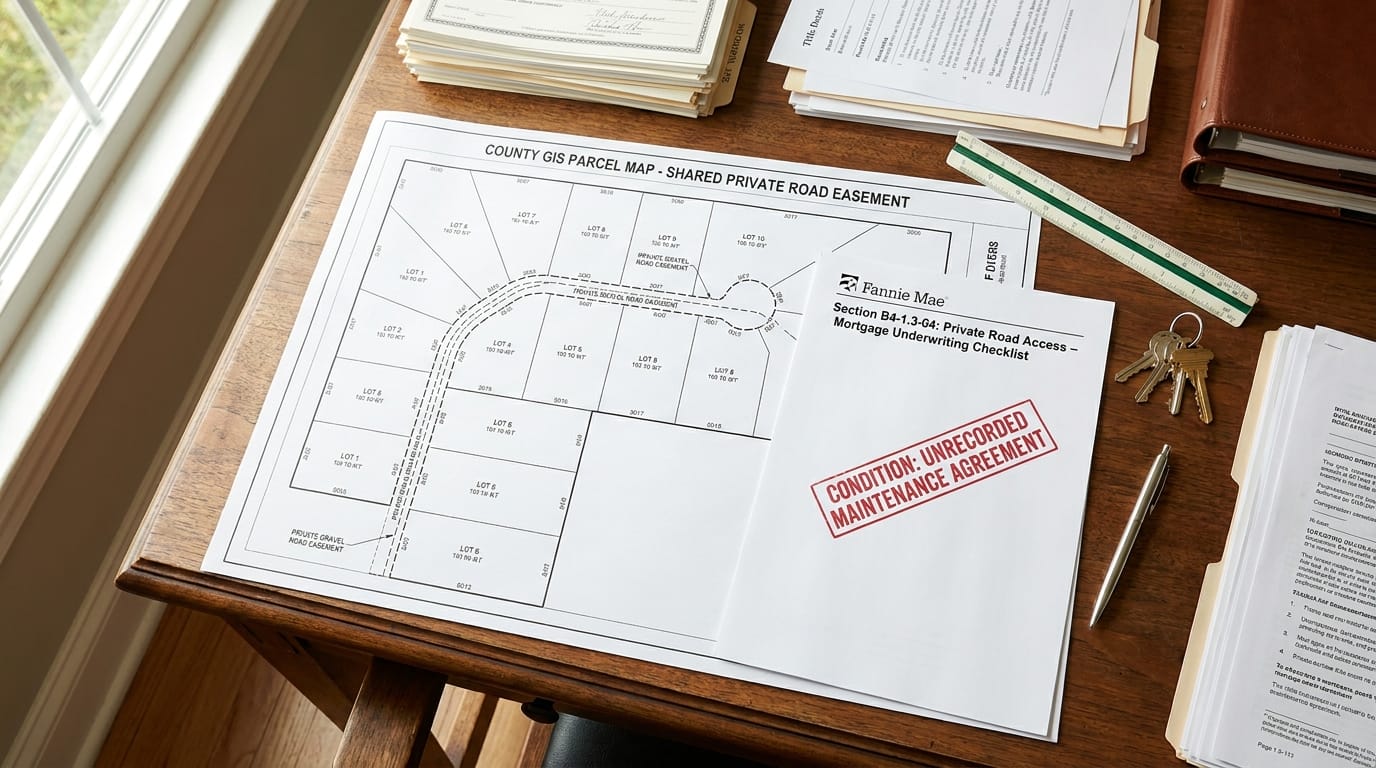
Buying a home on a private road or shared driveway comes with unique legal and financial rules. An informal handshake among neighbors to split snowplowing or gravel costs is not enough to get a conventional mortgage approved. Under Fannie Mae Selling Guide Section B4-1.3-04,
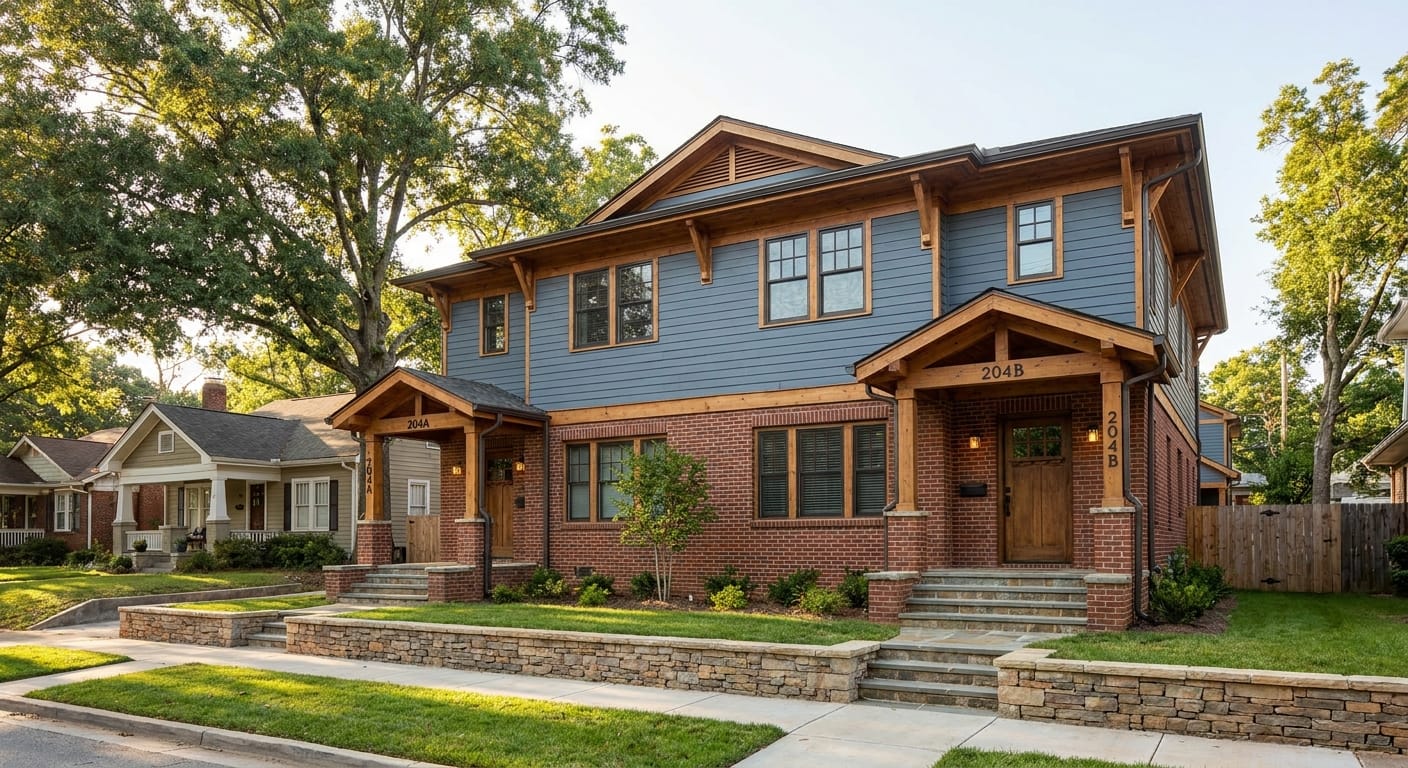
To combat a structural 1.9 million home shortfall across the United States, municipalities and state governments have been quietly passing sweeping "missing middle" housing legislation. This regulatory shift, gaining significant momentum between 2024 and 2026, effectively rolls back strict single-family-only zoning, a framework that has
The housing market is finding a new balance this April. With national price appreciation stalling at 0.5% and inventory rising nearly 10%, the dynamic is shifting. Sellers face an affordability ceiling as mortgage rates hold near 6%, and buyers are becoming more selective. To keep deals moving, 39% of